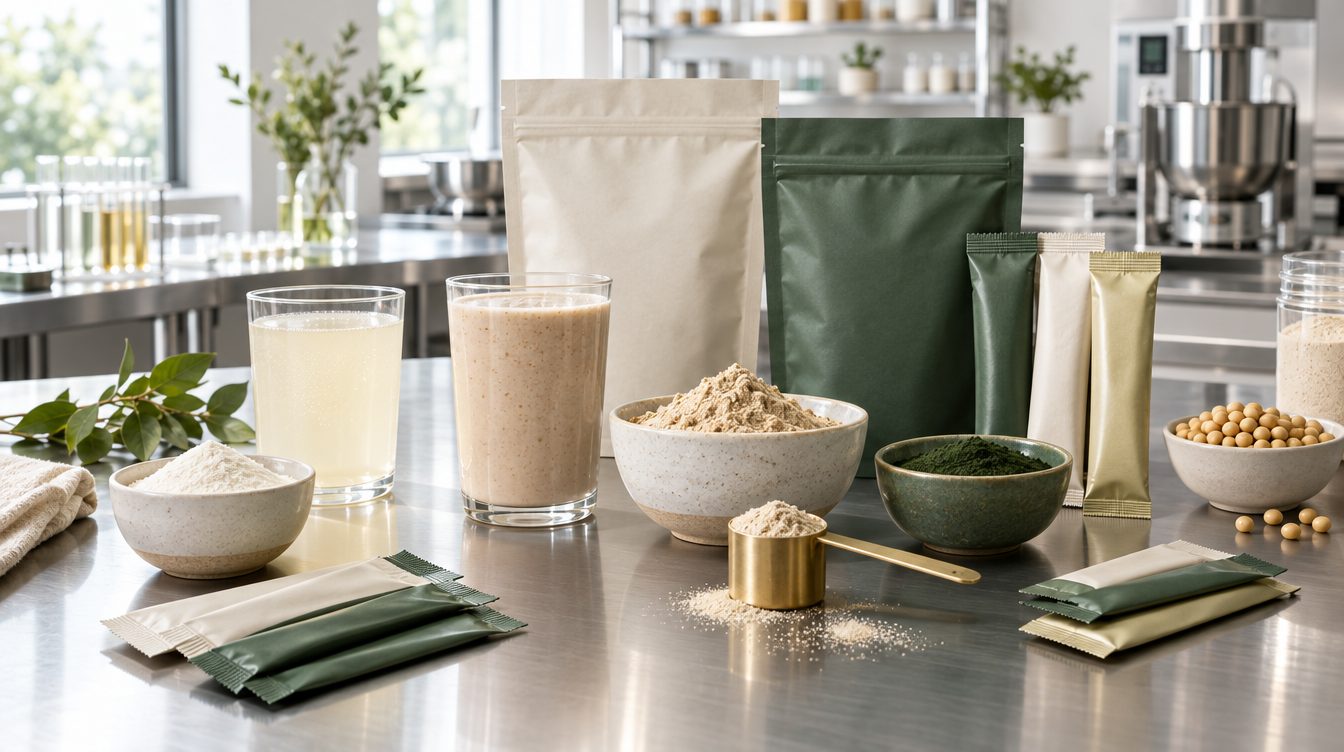
Collagen drinks, cultured milk premixes, plant-based protein powders, herbal tea blends: many of Malaysia’s fastest-growing wellness brands are not pills at all. They are food products made by an OEM food manufacturer. If you want to launch a functional food or food supplement in Malaysia, here is how OEM food manufacturing works, what to look for in a manufacturer, and how to keep your first launch affordable.
What does an OEM food manufacturer do?
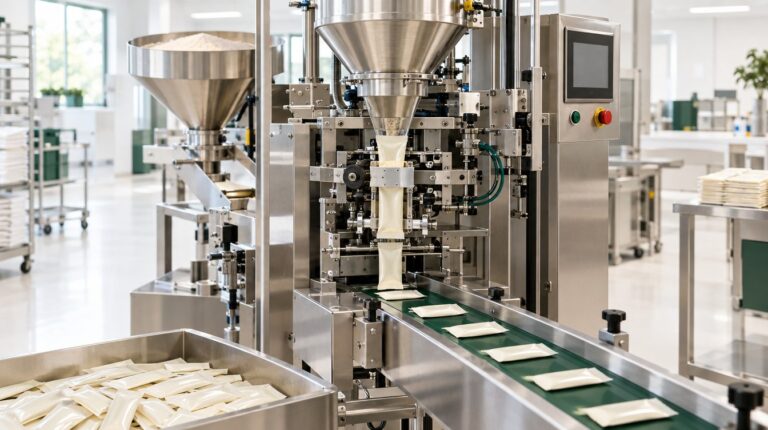
An original equipment manufacturer (OEM) produces food products to your specification, and you sell them under your own brand. Depending on the partner, OEM services can cover recipe and product formulation, ingredient sourcing, sampling, food safety testing, packaging and production. The alternative, ODM or private label, means choosing one of the manufacturer’s existing products and adding your label.
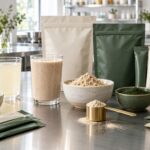
Food products a Malaysian OEM can make for health brands
- Food supplements in powder, sachet or stick-pack form
- Collagen drinks and beauty-from-within beverages
- Cultured, fermented and probiotic-style food premixes
- Plant-based protein and meal-replacement powders
- Herbal and botanical drink blends
- Functional food mixes, cereals and snack formats
Our own brand’s first product, nuvio-AD, is a good example: a cultured milk botanical premix in 3g sachets that melts on the tongue, made with fermented soy and an enzyme blend.
Food route vs. supplement route
In Malaysia, most functional foods and food supplements are regulated as food under the Food Act 1983 and Food Regulations 1985, overseen by the Food Safety and Quality Division of the Ministry of Health. This usually means a faster route to market than health supplements, which need NPRA product registration and a MAL number. The trade-off is that food products can only carry permitted nutrition and function claims, and must follow food labelling rules. Read our guide to NPRA product registration if you are unsure which route fits your idea.
How to choose an OEM food manufacturer in Malaysia
- Halal certification: for most Malaysian consumers and retailers, JAKIM Halal (or the state religious authority) is essential. Ask for the current certificate for the facility that will make your product.
- Food safety systems: look for MeSTI, GMP, HACCP or ISO 22000, depending on the product and facility.
- Formulation and R&D: can they adjust flavour, solubility and texture, or only repack a standard recipe?
- Quality control: what tests are done on each batch, and can they share certificates of analysis for key ingredients and their source?
- MOQ: is the minimum order realistic for a brand that is still proving demand?
- Export readiness: if you plan to sell in ASEAN or other export markets, ask what documentation they can support.
The OEM food manufacturing journey
- Brief: target customer, benefit, format, price point and claims.
- Product formulation and research and development, including flavour work.
- Sampling rounds until taste, texture and dissolution are right.
- Food safety and quality checks, shelf-life planning and label review.
- Packaging and first production run.
- Launch, collect feedback and refine before scaling.
Keep your first batch small
Many food manufacturers require large minimum order quantities. For a new brand, that ties up cash in stock instead of marketing. We offer MOQs from as low as 20kg, depending on format and formula, so you can launch, learn from real customers and then scale with confidence.
Work with formulators, not just a factory
Ethereal Superfood Synergy is led by a food formulator with 15 years’ experience and an ingredient specialist with 18 years in food-ingredient distribution. We develop your formula, then produce it through GMP and Halal-certified manufacturing partners. Tell us about your product idea, or start with our free founder’s guide below.
Related reading
- NPRA product registration in Malaysia: a founder’s guide
- Kilang OEM produk kesihatan: panduan lengkap (Bahasa Malaysia)
- Supplement formulation services
Free guide: launch your supplement brand in Malaysia
Regulatory routes, the OEM process step by step, MOQ and budget planning, and 15 questions to ask any manufacturer, in one practical 17-page PDF.